




Many customers ask the same question when they first receive a packaging solution: oneComposite Packaging BagsHow many layers are there? Why can’t a single layer of plastic film solve the problem? The answer lies in the product’s requirements for barrier properties, strength, heat resistance, and print quality. A single layer of film is difficult to meet all these conditions simultaneously. Therefore, factories combine two to five layers of complementary materials using adhesive or resin to create a composite film that performs each function effectively. This composite film is then slit, printed, and formed into the final product bag.
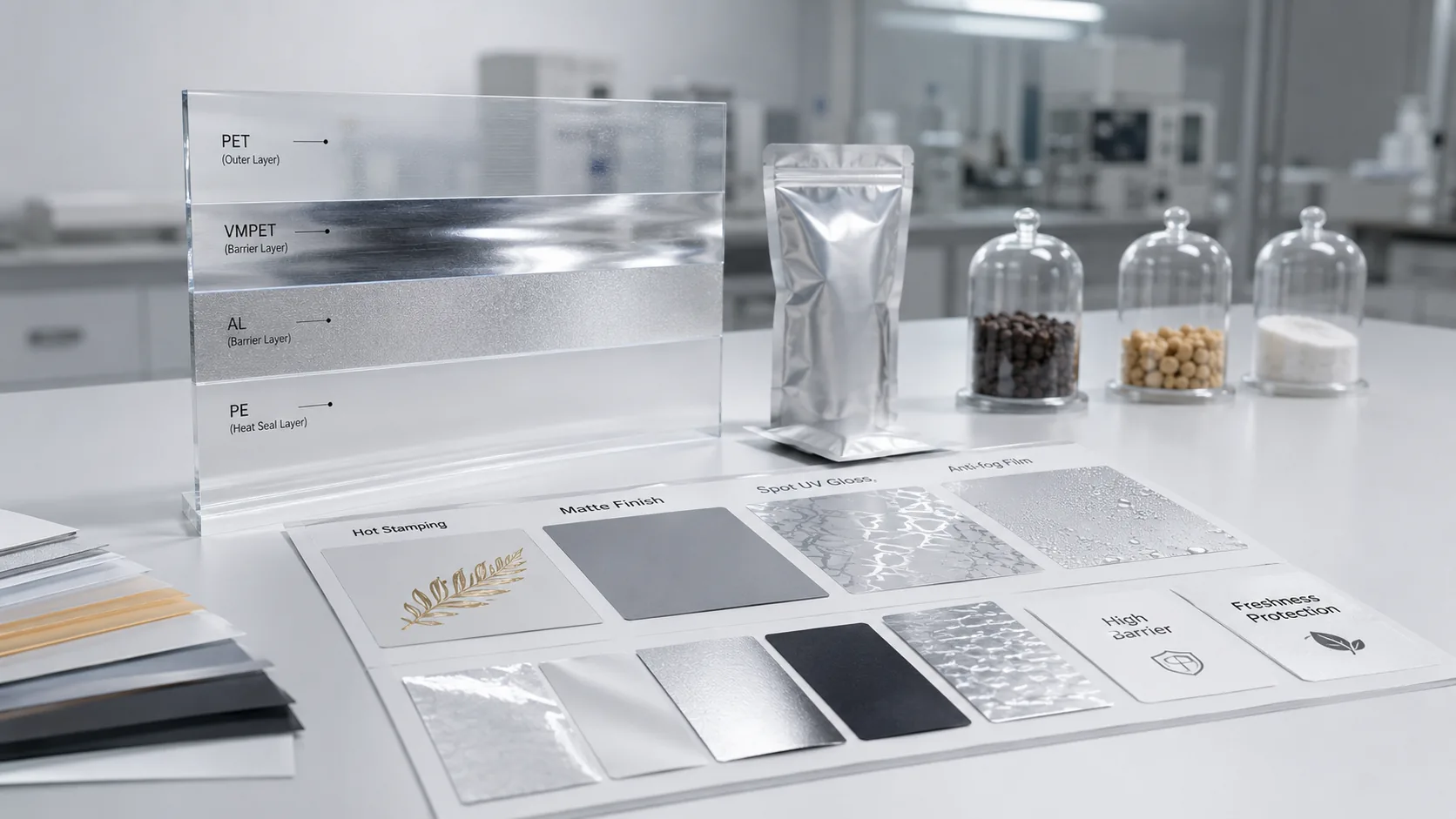
From the factory perspective, this explanation will clarify the logic of the number of layers in composite packaging bags, the functions each layer serves, and common mistakes in structural design, helping procurement and product teams understand the proposals more clearly.
Why composite packaging bags must be layered
The core contradiction of flexible packaging is: consumers want the packaging to be thin and inexpensive, while the product requires oxygen barrier, moisture barrier, light protection, heat resistance, puncture resistance, and good printability. No single material can fulfill all these requirements at the same time. PE has good sealing performance and flexibility, but it has low heat resistance and poor oxygen barrier properties; PET has highStiffness and good printability, but poor heat sealing performance; aluminum foil has nearly absolute barrier properties, but cannot be used as a standalone bag. By laminating them together, we can achieve the maximum functionality with the minimum total amount of material.
Layering also provides cost flexibility: the load-bearing layer and barrier layer can be made thinner, reserving thickness only where it is truly needed. For packaging bags with the same load capacity, different structural designs can result in weight differences of more than 20%.
Three-layer structure is the most common starting point.
Most food composite packaging bags on the market are three-layer structures, typically composed of 0 printing layer + barrier layer + heat-sealing layer 1. The printing layer usually uses PET or BOPP, responsible for carrying the graphics and ensuring the package’s appearance and rigidity. The middle layer is selected based on product requirements, such as aluminum foil, metallized film, EVOH, or PA, responsible for barrier properties and strength. The inner layer, PE or CPP, comes into direct contact with food, responsible for heat sealing and sealing strength.
The three-layer structure achieves a balance between cost, processing difficulty, and performance, making it suitable for ambient temperature circulation scenarios such as nuts, biscuits, seasonings, and daily chemical products. If the product only requires basic moisture resistance, the middle layer can be replaced with a metallized film, which maintains the metallic appearance while reducing the weight. For differences between various composite structures, please refer to the following.Composite Packaging Process Overview。
Four-Layer and Five-Layer Structures: When to Add Layers
When high-temperature sterilization, long shelf life, or strong puncture resistance is required, a three-layer structure is insufficient. Four-layer and five-layer structures typically add a layer of PA nylon to enhance puncture resistance and heat resistance, or add an aluminum foil layer to maximize barrier properties. A typical sterilization structure, such as PET/PA/AL/CPP, can maintain seal integrity and prevent delamination under 121°C sterilization conditions.
Adding more layers is not always better. Each additional layer increases the number of lamination passes, adhesive usage, loss rate, and process time, leading to higher costs. The sole criterion for determining whether to add layers is whether a specific failure mode has occurred in the existing structure during actual testing, such as excessive oxygen permeability, damage from drop testing, or delamination after sterilization. Adding layers should only be done when there is a clear cause of failure, making it a rational engineering decision.
What Each Layer Does: Material Code Quick Reference
- PETOuter layer commonly used, high stiffness, good heat resistance, good printing effect, provides mechanical strength.
- BOPPOuter layer alternative, low cost, high gloss, but lower heat resistance compared to PET.
- Aluminum FoilBest barrier performance, suitable for light-blocking and high oxygen barrier applications.
- VMPEt metallized filmLow-cost barrier solution with a metallic appearance.
- Nylon PAPuncture-resistant and stretch-resistant, they are common choices for frozen and steam-cooked structures.
- EVOHClear high barrier material, suitable for products that require displaying their contents.
- PE / CPPThe inner heat-seal material determines the seal strength and integrity of the closure.
Three Common Mistakes in Structural Design
The first misconception is focusing only on barrier performance without considering sealing reliability. Even with excellent barrier structure, if the inner heat-seal window is too narrow, the sealing process on the production line will be unstable, leading to unmet shelf life requirements. The second misconception is neglecting the oil content and acidity of the product. Oil-based foods can accelerate swelling of certain adhesive layers, while acidic contents impose higher requirements on the aluminum foil layer. Products of this type require specialized content resistance testing.
The third misconception is blindly copying others’ structures. For the same type of nut product, factors such as moisture content, packaging specifications, transportation distance, and target shelf life can vary, leading to different optimal structures. Directly applying a competitor’s formula may result in either over-performance with high costs or failure in a specific path. A more reliable approach is to provide product parameters and distribution conditions, allowing the factory to offer two to three candidate structures for sample testing and verification.
Verification process from the structural diagram to the physical product
After the structure is determined, verification is typically divided into four steps: first, produce a small sample composite to confirm the adhesion strength of each layer. Then, create a bag sample to confirm the heat sealing parameters and bag dimensions. Next, conduct content filling tests. Finally, arrange for accelerated or actual shelf life observation. It is recommended to request peel strength, seal strength, and oxygen and moisture barrier data during the sample stage as reference benchmarks for subsequent large-scale production acceptance. For sterilized products, additional confirmation of appearance and layering after heat resistance is required, which can be referenced.High Temperature Steam Sterilization Bag Material Combination Solutions。
Frequently Asked Questions
Q: Does more layers mean safer packaging? A: Safety depends on whether the structure matches the contents, not the number of layers. Increasing the number of layers mainly enhances barrier properties and mechanical strength, which have no direct relation to food contact safety. Safety is determined by material compliance and seal integrity.
Q: Can aluminum foil be replaced with metallized film to reduce costs? A: If the product has moderate sensitivity to oxygen and light and a short shelf life, metallized film is a viable option. However, if the product requires a long shelf life or strong light protection, aluminum foil remains irreplaceable.
Conclusion
Understanding the logic of composite packaging bag layers essentially means translating the required performance of the packaging into what each layer should do. The earlier the structure is confirmed, the fewer sample runs and the lower the cost of revisions in the later stages. If you are currently advancing a new packaging product project, welcome to join.Contact Huashu PackagingGet structural evaluation and sample-making suggestions; for small-batch packaging solutions for cross-border retail, you can also learn about OME Packaging. https://www.omopack.cn。