




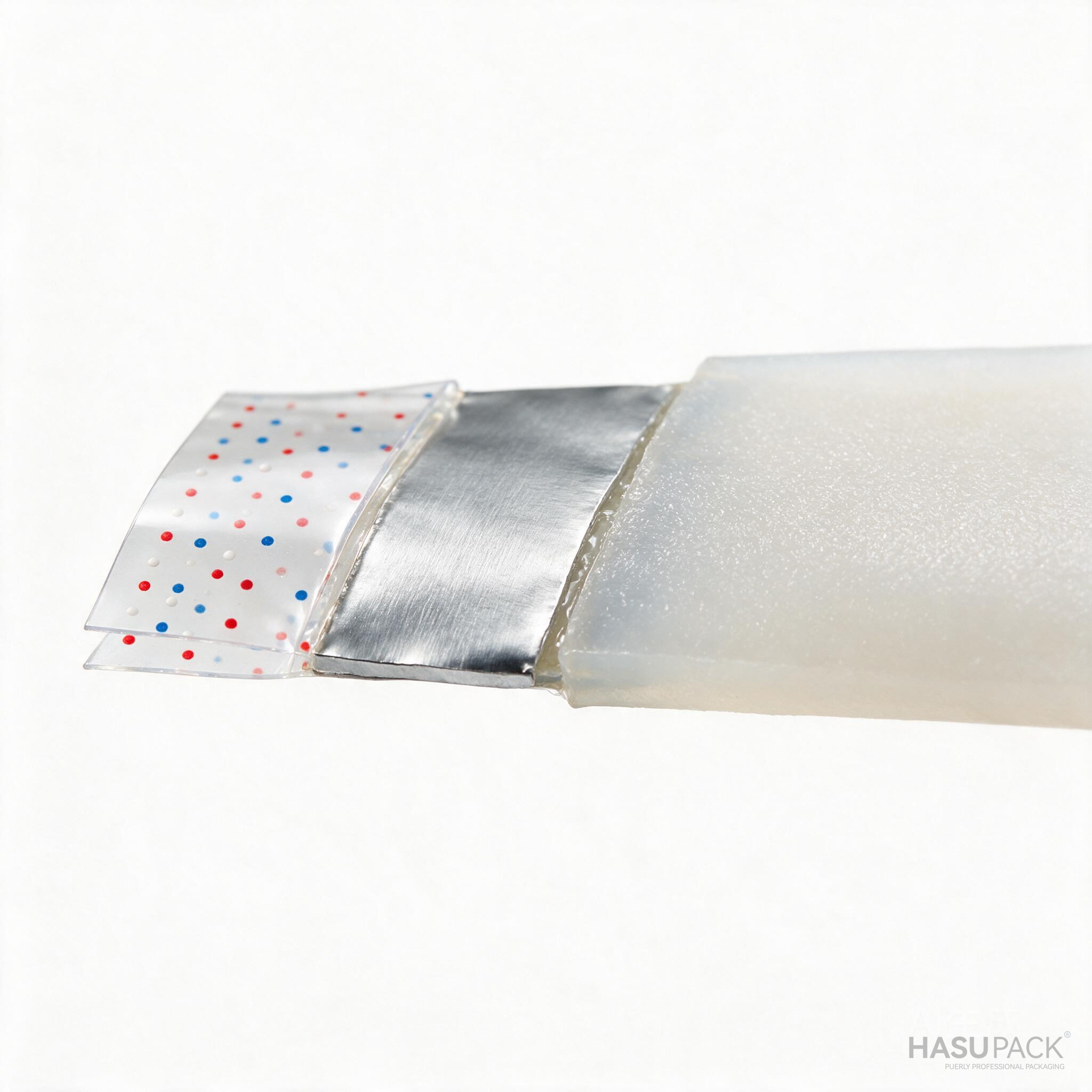
Walk through the supermarket shelves, from potato chip bags to coffee bags, from milk cartons to seasoning packaging—most packaging is not made from a single material. Why don’t food packages simply use a single layer of plastic instead of the time-consuming and complicated process of combining multiple layers? This article will reveal the answer.Composite Packaging MaterialsUnveiling the mystery, systematically interpreting the secrets of multi-layer composites from structural design to practical applications.
I. Why is single-layer material insufficient? The contradiction of packaging 0 all-round 1
An ideal food packaging bag must meet several seemingly conflicting requirements: it needs to be oxygen and moisture barrier to preserve freshness, yet also capable of heat-sealing; it should have sufficient mechanical strength while maintaining good printability; it must be safe and non-toxic, yet cost-effective. Unfortunately, no single-layer material can fulfill all these requirements simultaneously.
Taking PE bags as an example, polyethylene has excellent heat-sealing properties and good flexibility, but poor barrier properties against oxygen and aroma. Aluminum foil has excellent barrier properties, but cannot be heat-sealed, is not resistant to bending, and is opaque. PET film has good printability and high strength, but poor heat-sealing performance and average moisture barrier properties. Each material has its own strengths and weaknesses.Composite Flexible PackagingThe core concept is to combine the advantages of different materials to achieve more than the sum of its parts, creating 1+1>2.
A typical composite packaging structure consists of three layers: the outer layer (print layer, such as PET or BOPP), the middle layer (barrier layer, such as aluminum foil or EVOH), and the inner layer (heat-seal layer, such as PE or CPP). Each layer serves a specific function, collectively forming a comprehensive packaging solution.
II. Common Combinations of Composite Packaging Materials
The variety of composite packaging materials and combinations available in the market is extensive. Below are several classic combinations and their applicable scenarios:
(1) Three-layer composite of PET/AL/PEThis is the most classic high barrier composite structure. PET provides excellent printability and strength, while AL offers superior oxygen and moisture barrier properties. PE is responsible for heat sealing. This structure is commonly used for food that requires long-term preservation, such as coffee bags, tea bags, and spice packaging. The disadvantage is that it contains aluminum foil, making it opaque, and it is difficult to recycle.
(2) PET/EVOH/PE Transparent High Barrier StructureEVOH (Ethylene-Vinyl Alcohol Copolymer) is a transparent high barrier material with extremely low oxygen permeability, while maintaining the transparency and visibility of the packaging. This combination is suitable for applications where product display is required, such as premium meat packaging and cheese packaging. A drawback of EVOH is that its barrier properties decrease when it absorbs moisture, so it is typically protected by being sandwiched between PET and PE.
(3) BOPP/CPP Full PP Laminated FilmBOPP (biaxially oriented polypropylene) has good rigidity and high transparency, while CPP (cast polypropylene) has excellent heat-sealing properties. The all-PP structure isSingle-material packagingIt is a representative material, although its barrier properties are not as good as those of aluminum foil-containing structures, it has excellent recyclability, making it one of the fastest-growing composite methods in the trend toward environmental protection.
(4) PET/VMPET/PE Aluminized CompositeVMPET (aluminum-coated polyester film) is a thin layer of aluminum vapor-deposited on the surface of PET, offering barrier properties second only to pure aluminum foil, while being lower in cost and thinner. It is suitable for packaging with moderate barrier requirements, such as snack bags and outer bags for frozen food.
III. Production Process of Composite Packaging Materials
Bonding different materials is not a simple task. Currently, the three main composite processes are as follows:
Dry LaminationA bonding agent is applied to the surface of the film, then the solvent is evaporated in the drying tunnel before the film is laminated with another layer. Dry lamination is the most mature lamination process, suitable for most material combinations. However, it requires the use of organic solvents, posing risks of residual solvent and environmental pressure. Dry lamination offers high peel strength, making it suitable for high-quality food packaging.
Solvent-free laminationUsing 100% solid content solvent-free adhesive, there is no need for a drying process; two layers of film can be directly laminated. Solvent-free lamination is an upgraded direction under the trend of environmental protection, with no solvent emissions, low energy consumption, and higher food safety. However, the initial peel strength of solvent-free adhesive is relatively low, requiring more precise production operations.
Extrusion CoatingExtrusion lamination involves directly extruding molten PE resin between two layers of film, serving both as an adhesive and as the intermediate layer. Extrusion lamination is suitable for high-volume, cost-sensitive packaging applications such as laundry detergent bags and rice bags. Its advantages include being solvent-free and cost-effective, while its disadvantages are limited material selection and constraints on lamination accuracy.
The choice of composite process depends on the comprehensive requirements of food safety, peel strength, and production efficiency for the product. For more professional information on composite processes, you can refer to our written materials.Composite Packaging Process Overview。
Huashu Packaging has two fully automatic dry-lamination and solvent-free lamination production lines, and can recommend the optimal lamination solution based on your product requirements.
IV. Key Quality Indicators for Composite Packaging Materials
To assess the quality of composite packaging materials, the following key indicators should be considered:
1. Tensile strengthAdhesion strength between layers. Insufficient peel strength can cause delamination and blistering, significantly affecting the package’s barrier properties and appearance. High-quality composite packaging typically has a peel strength of ≥1.5N/15mm.
2. Residual SolventsIn dry laminating processes, if organic solvents are not thoroughly dried, residual substances such as toluene and ethyl acetate may migrate into food, causing safety issues. The total residual solvent content in food packaging laminates should be ≤5mg/m².
3. Sealing StrengthThe heat-seal strength of the inner layer determines whether the package remains intact during transportation and storage. A heat-seal strength of ≥20N/15mm is a basic requirement for most food packaging.
4. Barrier PerformanceIncluding oxygen transmission rate (OTR) and water vapor transmission rate (WVTR). For high barrier packaging, OTR should be ≤5 cm³/(m²·24h·atm), and WVTR should be ≤2 g/(m²·24h).
V. Industry Trends of Composite Packaging Materials
Looking ahead,Composite Packaging MaterialsMoving towards a more environmentally friendly and high-performance direction:
Single-material recyclableThe demand for recyclable packaging is increasing in markets such as Europe, the US, Japan, and South Korea. Single-material composite packaging with all PE or all PP structures has become a research focus. Although its barrier properties are still not as good as those of multi-material composites, they are continuously improving through coating technologies and the application of new materials.
Applications of Biobased MaterialsBiobased materials such as PE derived from sugarcane and PLA derived from corn are beginning to enter the composite packaging field. These materials can reduce reliance on fossil fuels and lower the carbon footprint.
Thinning and LightweightingBy optimizing structural design and material selection, we reduce the total film thickness without compromising performance, achieving material reduction and cost savings. For example, with a three-side-sealed bag, reducing the thickness from 120μm to 90μm saves approximately 25% of material usage.
HuaShu Packaging has been specializing in the research and production of composite flexible packaging materials for 15 years, offering customers full-chain services from material selection to final product delivery. Contact us now to obtain the most suitable composite packaging solution for your product.
From single-layer 1 to multi-layer composite 2, each material upgrade represents an ultimate pursuit of food preservation and packaging efficiency. Understand.Composite Packaging MaterialsThe basic principles will help you make more scientific and cost-effective decisions when purchasing packaging. If you need sample testing or technical consultation, feel free to contact the Huashu Packaging team at any time.