




Food packaging bags may seem like just a simple bag, but the choice of packaging material often greatly affects product freshness, sealing, display, and transportation safety. Different foods have different packaging requirements. For example, nuts focus more on moisture protection, coffee emphasizes barrier properties and gas release, frozen foods prioritize low-temperature resistance, and snack packaging places greater emphasis on print quality and shelf display.
For brand owners, selecting the right material for food packaging bags is not just about “being able to hold the product,” but also about maintaining the product’s optimal condition during storage, transportation, sales, and consumer use.
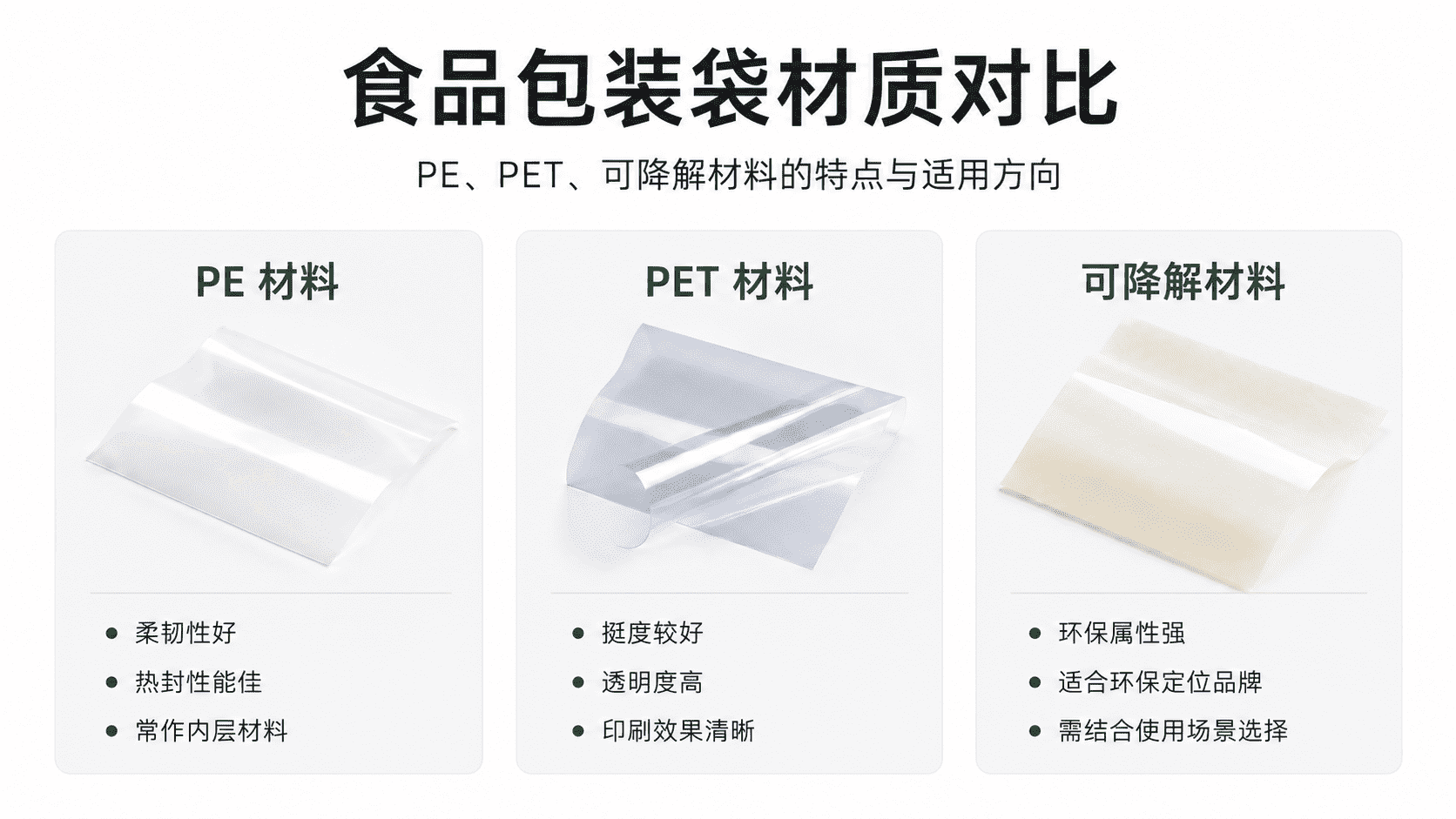
1. PE Material: Good flexibility, commonly used for inner heat sealing
PE is a commonly used material in food packaging, offering good flexibility and heat-sealing properties. Many composite food packaging bags use PE as the inner layer material because it helps achieve a good sealing effect.
PE material is suitable for packaging applications such as snacks, nuts, seasonings, pet food, and frozen food. Its advantages include a soft feel, stable sealing performance, and wide applicability. However, its barrier properties are relatively limited when used alone. Therefore, it is often combined with materials such as PET, PA, VMPET, and AL in many food packaging solutions.
Common applications include:
- Inner Layer of Food Standalone Bag
- Three-side sealed food bag inner layer
- Inner Layer of Octagonal Bag for Nuts
- Freezing Food Packaging Bags
- Pet Food Snack Packaging Bag
If the product has high requirements for moisture resistance, oxidation prevention, and light protection, it is generally not recommended to use a single-layer PE alone. Instead, a composite structure should be selected based on the product’s characteristics.
II. PET Material: Good stiffness, clear printing effect
PET is one of the common outer materials used in food packaging. It features good stiffness, high transparency, and stable print performance, making it suitable for food packaging that requires a high visual presentation effect.
Many food packaging bags use PET material for the outer layer because it allows for a flatter packaging surface and clearer presentation of graphics and text. For standalone brand products, e-commerce food items, premium snacks, coffee, and tea, PET can enhance the overall quality and sophistication of the packaging.
Common advantages of PET include:
- Printing pattern is clearer
- Good bag body stiffness
- More stable surface texture
- Suitable for composite materials with multiple functions
- Suitable for glossy film, matte film and other surface effects
For example, a nut eight-seal bag can use a PET/VMPET/PE structure, where the outer layer is responsible for printing and display, the middle layer enhances barrier properties, and the inner layer ensures heat-sealing for sealing. This approach ensures both good appearance and meets food preservation requirements.
III. Biodegradable Materials: Suitable for eco-friendly brand positioning, but should be combined with actual usage scenarios.
With the increasing demand for eco-friendly packaging, biodegradable food packaging has attracted growing attention from brands. Biodegradable materials are typically suitable for lightweight food packaging, single-use packaging, short-term usage scenarios, and products emphasizing environmental concepts.
However, biodegradable materials are not a universal alternative for all food packaging. Different biodegradable materials vary in terms of heat resistance, barrier properties, strength, heat-sealing stability, and cost. If the product requires a longer shelf life, high barrier properties, moisture resistance, oil resistance, or freezer storage, the material structure should be evaluated based on actual requirements.
Products suitable for consideration of biodegradable packaging include:
- Light Food
- Bakery Products
- Dry Goods Small Packaging
- Eco-Friendly Brand Sample Set
- Disposable Food Packaging
- Partial Short Shelf Life Food Packaging
If a brand emphasizes an eco-friendly concept, biodegradable packaging can help enhance the brand image. However, before proceeding with mass production, it is recommended to conduct sample testing to confirm the packaging’s strength, sealing, printing, and storage performance meet product requirements.
Four. How to choose packaging materials for different foods?
Different foods have different functional requirements for packaging bags, so material selection should not be based solely on price or appearance.
1. Nuts and dried fruit products
Nuts and dried fruits are prone to moisture absorption and oxidation. The packaging bag should focus on moisture-proof, barrier, and sealing properties.
Recommended Direction:
PET/VMPET/PE, PET/AL/PE, PET/PE, etc. composite structures.
Suitable bag types:
Eight-sided bag, stand-up zipper bag, three-sided sealed bag.
2. Coffee Packaging
Coffee has high requirements for barrier properties, especially needing to reduce the impact of oxygen, moisture, and light on coffee flavor. If it’s packaging for coffee beans, a one-wayVentilation valve design can also be added.
Recommended Direction:
PET / AL / PE, PET / VMPET / PE, Kraft Paper / VMPET / PE.
Suitable bag types:
Octagonal coffee bag, stand-up bag, gusseted bag.
3. Potato Chips, Expanded Food
Potato chips and expanded snacks require packaging with good barrier properties, while also needing excellent display effects. Roll film packaging and middle-seal bags are common choices.
Recommended Direction:
PET / VMPET / PE、BOPP / VMPET / PE。
Suitable bag types:
Sealed bag, roll film packaging, pillow-type packaging bag.
4. Frozen Food
Freezing food packaging should focus on low-temperature resistance, puncture resistance, and seal stability. If the packaging becomes brittle in low-temperature environments, it may affect transportation and storage safety.
Recommended Direction:
PET/PE, PA/PE, etc. composite structures.
Suitable bag types:
Three-sided sealed bag, four-sided sealed bag, stand-up bag.
5. Pet Food and Pet Treats
Pet food packaging typically requires high performance in terms of load-bearing capacity, sealing, moisture resistance, and puncture resistance. For large capacity packaging, the thickness of the bag body and the structure of the bottom also need to be considered.
Recommended Direction:
PET / PE、PET / VMPET / PE、PET / AL / PE。
Suitable bag types:
Stand-up zipper bag, 8-side sealed bag, large capacity flat bottom bag.
Five. Core Logic for Choosing Food Packaging Bag Materials
When choosing the material for food packaging bags, you can start by considering the following questions:
First, is the product moisture-sensitive?
If the product is prone to moisture absorption, it is necessary to choose composite materials with better moisture-proof performance.
Second, is the product prone to oxidation?
If the product is prone to oxidation and deterioration, such as nuts, coffee, and tea, a higher barrier structure should be considered.
Third, does the product require light protection?
If the contents are light-sensitive, consider adding metallized or aluminum foil materials.
Fourth, does the packaging need to showcase texture?
If the product takes a premium approach, visual appeal can be enhanced through processes such as PET outer layer, matte film, soft-touch film, localized UV, and foil stamping.
Fifth, is an eco-friendly positioning needed?
If a brand emphasizes an eco-friendly concept, consider options such as paper-plastic composite, biodegradable materials, or recyclable materials. However, this should be evaluated in combination with the product’s shelf life and usage environment.
Six. Food packaging bags not only require selection of material, but also the right bag type.
The material determines the functional basis of the packaging, while the bag type influences the display and usage experience. Common food packaging bag types include three-side sealed bags, stand-up bags, eight-side sealed bags, middle-sealed bags, roll film packaging, and accordion bags.
If the product requires shelf display, choose a stand-up pouch or an octagonal pouch.
If the product is sold in small packaging for e-commerce, you can choose three-side sealed bags or middle-sealed bags.
If the product requires automatic packaging machine production, roll film packaging can be selected.
If the product volume is large, choose an octagonal seal bag or a large-capacity stand-up bag.
Therefore, customized food packaging is not simply choosing a material, but involves a comprehensive determination of the packaging solution based on product type, capacity specifications, storage methods, sales channels, and brand positioning.
Seven. Conclusion: Appropriate packaging materials can add more value to food packaging.
The choice of material for food packaging directly affects product freshness, transportation stability, shelf display, and consumer experience. PE, PET, and biodegradable materials each have their own characteristics, and none is necessarily better than the others. The key is whether the material is suitable for the specific product.
For food brands, good packaging should achieve three objectives: product protection, enhanced display, and assistance in sales.
If you are looking for customized food packaging solutions, you can choose the most suitable composite materials, bag structures, and surface treatments based on product type, capacity, shelf life, usage scenarios, and design requirements. Professional packaging manufacturers can also provide one-stop customization services, including material recommendations, bag design selection, sample production, and mass production, based on samples, design drafts, or reference images.
Common Packaging Material Comparison
| Material | Features | Environmental Friendliness |
|---|---|---|
| PE | Flexible, cost-effective | Recyclable |
| PET | Clear, high strength | Recyclable |
| Biodegradable Materials | Eco-friendly, compostable | Biodegradable |
Please refer to Ohm’s packaging material knowledge for details.