




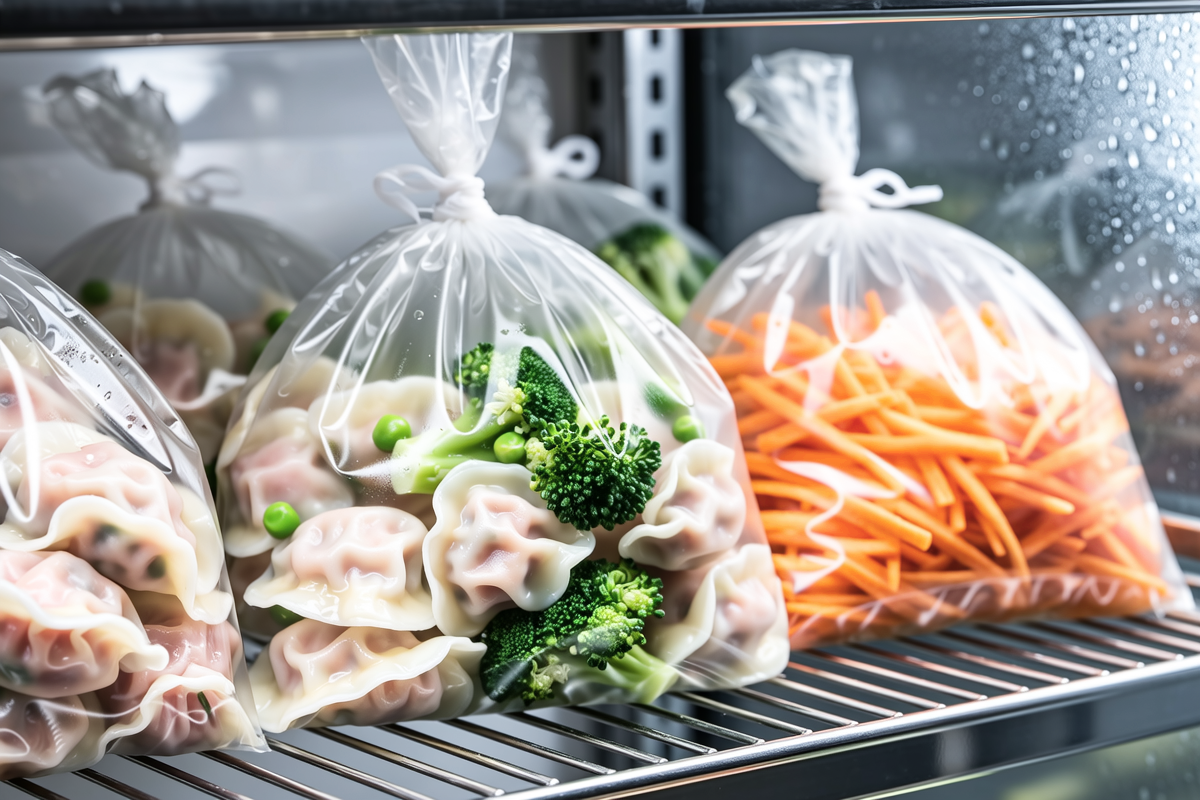
Low-temperature frozen packaging bags are essential protective packaging in the circulation of frozen food. Quick-frozen dumplings, frozen seafood, ice cream, ready-made meals… These products start from factory cold storage, go through cold chain transportation, supermarket cold cabinets, and finally reach home refrigerators. The entire process relies on a reliable low-temperature frozen packaging bag. Choosing the wrong packaging can result in product dehydration and loss of quality, or even freezing burn and bag rupture, leading to leakage and total batch loss. This article thoroughly explains low-temperature frozen packaging bags from four aspects: materials, structure, bag type, and customization.
Why do frozen foods require specialized low-temperature freezing packaging bags?
Many people believe that any bag capable of holding items can be used for frozen food, which is a common misconception. Ordinary packaging bags perform adequately at room temperature, but problems become apparent when they are exposed to low-temperature environments such as -18°C or even lower. First is low-temperature brittleness: most ordinary plastic films become hard and brittle at low temperatures, leading to a significant decrease in impact resistance. A slight bump during handling can easily cause them to rupture. Second is dry loss and freezer burn: in a frozen environment with low humidity, moisture inside the bag slowly evaporates through the film, causing the product’s surface to lose moisture and appear white, a phenomenon commonly known as freezer burn. This severely affects the color and texture of meat. Third is flavor transfer and oxidation: in a freezer where various ingredients are stored together, bags with insufficient barrier properties cannot prevent odor penetration. The fishy smell of seafood may transfer to ice cream. Therefore, low-temperature frozen packaging bags must meet requirements for low-temperature resistance, puncture resistance, high barrier properties, and good sealing performance. This is the fundamental difference between them and ordinary packaging bags.
How to choose the material for low-temperature frozen packaging bags
Material selection for low-temperature frozen packaging bags focuses on balancing low-temperature resistance with barrier requirements. Polyethylene (PE) is one of the best general-purpose materials for low-temperature resistance. LDPE and LLDPE maintain good flexibility even at temperatures ranging from -18°C to -40°C, making them ideal for the inner layer (heat-seal layer) of frozen food bags. If stronger barrier properties are required, such as to prevent oxidation and flavor transfer in meat and seafood products, nylon (PA) or aluminum foil layers should be incorporated into the structure: PA offers excellent puncture resistance and low-temperature performance, making it suitable for frozen products with bones or shells; aluminum foil or metallized layers significantly reduce oxygen and water vapor permeability, extending the frozen shelf life. Common frozen food packaging structures include PA/PE, PET/PE, and PET/AL/PE. The choice of structure depends on the product form, freezing temperature, and expected storage duration.
Common Low-Temperature Freezing Packaging Bag Types and Structural Design
Once the material is determined, the appropriate bag type and structure should also be selected. Frozen dumplings, tangyuan, and similar products are commonly packaged in three-side sealed bags or middle-sealed bags, which offer flat packaging, cost control, and are suitable for high-speed automatic packaging lines. Large pieces such as frozen seafood and steaks are better suited for stand-up bags with self-standing functionality, which facilitate upright display and make it easier for consumers to reseal the package. Frozen ready meals with liquid fillings require flat bags or pleated bags with excellent puncture resistance, along with sufficient heat-seal edge width. In terms of structural design, several details are worth noting: first, the strength of the seal. Frozen products are subject to compression and impact during transportation, and insufficient heat-seal strength can lead to cracking at the sealed area. Second, tearable design. Consumers’ finger dexterity decreases in low-temperature environments, so a well-designed tearable opening can significantly improve the user experience. Third, printing ink. The inner layer that comes into direct contact with food must never be printed, and the outer layer ink must also meet food packaging safety standards.
Custom Low-Temperature Freezing Packaging Bags: Four Parameters to Confirm
When customizing low-temperature frozen packaging bags, companies often make the mistake of only specifying dimensions and quantities while neglecting key usage parameters. The first essential parameter to confirm is the freezing temperature: ordinary freezing (-18°C) and deep freezing (below -40°C) require completely different film formulations. The lower the temperature, the higher the requirements for low-temperature additives and material selection. The second is the storage period: short-turnover products can use ordinary PE structures, while meat and seafood requiring long-term freezing should choose high-barrier structures containing PA or aluminum foil. The third is the packaging method: manual bagging, semi-automatic sealing, and fully automatic high-speed packaging lines have significant differences in requirements for bag dimensions tolerance, heat sealing temperature, and opening performance. The fourth is the transportation environment: stacking pressure during long-distance cold chain transport and impact from forklift handling should be verified through low-temperature drop testing during sample production. Confirming these four parameters before sample production can prevent most quality issues during mass production.
Conclusion: Hand over low-temperature frozen packaging bags to professional factories
Low-temperature frozen packaging bags may seem like just a simple bag, but in reality, they involve a systematic engineering process including high molecular materials, composite technology, printing inks, and bag-making techniques. Incorrect material selection or structural shortcuts can lead to problems only when the product is thawed, by which time the damage has already been done. For products requiring frozen packaging, it is recommended to prioritize factories with experience in frozen food packaging and to complete low-temperature drop, sealing, and barrier property tests before mass production. Regarding the relationship between packaging moisture-proofing and freshness preservation, you can refer to our previous discussion.Detailed Explanation of Moisture-Proof Packaging MaterialsIf you would like to learn more about the differences between various bag types, you can also read this article.Difference Between Stand-Up Bags and Regular Bags。
Huashu Packaging has been deeply involved in the flexible packaging industry for many years, offering one-stop services from low-temperature frozen packaging bag structure design, sample making to mass production. All materials comply with food contact material safety standards. If you are looking for a reliable packaging solution for frozen food, welcome to contact us.Contact Huashu PackagingGet free sample and selection advice, or visit the Brother brand website.Om PackagingLearn more about cross-border food packaging solutions.