




Medical Packaging MaterialsSterilization is a requirement for medical devices at the time of manufacture, but sterilization is not a property of the product itself, but rather a process applied to ensure the product is free from viable microorganisms.Status of the Packaging SystemA qualified medical packaging system must continuously prevent microbial contamination throughout the entire chain of sterilization, transportation, storage, and clinical use, until the moment of opening. This article focuses on the core selection logic of medical packaging materials and provides a compliance guide for medical device enterprises.
I. Dual Role of Medical Packaging Materials: Sterile Barrier + Transportation Protection
Medical packaging is defined under the framework of ISO 11607 asSterile Barrier System (SBS)byPrimary Packaging(Direct Contact Instruments) andSecondary PackagingThe outer packaging box/paper box forms the secondary packaging, while the primary packaging is the core—it must allow sterilizing agents to penetrate during the sterilization process and then completely block microorganisms until the package is opened at the point of use.
Key JudgementSelecting medical packaging materials essentially involves finding a balance between sterilization penetration and microbial barrier properties—two inherently conflicting factors. Good materials must do the right thing at the right time.
II. Dialysis Paper: The Classic Choice Between EO Sterilization and Steam Sterilization
2.1 Principle of Medical Dialysis Paper
Dialysis paper (Medical Grade Paper) is a classic material for medical paper-plastic packaging, with core characteristics ofPorous fiber structurePores are sufficiently large to allow sterilizing gases (EO ethylene oxide) or steam molecules to penetrate, while also being fine enough to form a barrier that prevents bacterial spores (generally 0.3 μm) from passing through after sterilization is complete.
| Specifications | Typical Values | Meaning |
|---|---|---|
| Basis Weight | 60—120 g/m² | The heavier, the higher the strength and the better the antibacterial properties. |
| Porosity | 40%—60% | Factors Affecting Sterilization Penetration Speed |
| Surface water absorption (Cobb value) | < 20 g/m² | The lower the value, the better the strength retention after moisture exposure. |
| Particle shedding | 0 100 particles/100 cm² | The lower the value, the lower the risk of surface contamination of the instrument. |
2.2 Common Composite Structures of Dialysis Paper and Film
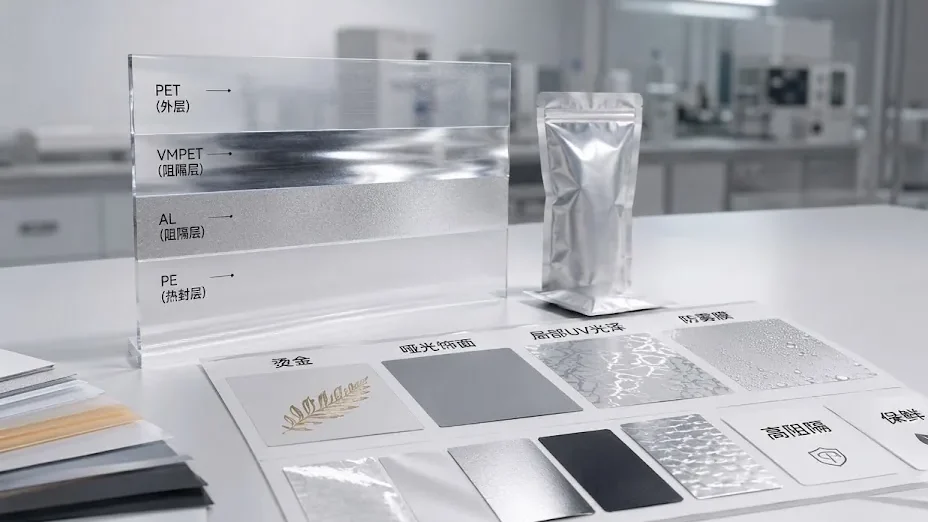
In actual medical packaging, dialysis paper is rarely used alone, but is combined with plastic film to form a composite structure.Paper-plastic bag (Pouch):
[Dialysis Paper Layer] ← Side for penetration of sterilizing gas, side for bacterial barrier
[Heat-Sealed Layer] ← Critical layer for sealing strength
[Plastic Film Layer] ← Transparent visible side, mechanical strength support
In this structure, the dialysis paper determines whether sterilization is possible (1) and whether bacteria are blocked (3), while the plastic film determines whether it is resistant to transportation (5) and whether the instruments can be seen clearly (7).
III. Tyvek: An Upgraded Choice for High-End Medical Equipment
When the device is high-value, has a complex shape, or has zero tolerance for particulate contamination,Tyvek (Tyvek) It is often a better choice than dialysis paper.
Tyvek is developed by DuPont.High-density polyethylene fiber materialLooks like paper but performs more like nonwoven fabric. Compared to medical dialysis paper:
| Comparison Dimensions | Medical Dialysis Paper | Tyvek |
|---|---|---|
| Microbial Barrier | Superior | Better (finer fibers) |
| Liquid-proof | General | Superior |
| Tear Strength | General (Easy to Wet and Break) | Excellent |
| Particle shedding | Controllable | Very low |
| Cost | Lower | Higher (about 3–5 times) |
| Sterilization Methods Applicable | EO, Steam | EO, Gamma, Electron Beam |
Selection RecommendationsFor general single-use instruments (syringes, dressings), standard dialysis paper is sufficient; for implants, high-end surgical instruments, and high-end equipment for export to Europe and the US, it is recommended to upgrade to Tyvek.
Four. Compatibility Matrix of Sterilization Methods and Packaging Materials
Different sterilization methods impose significantly different requirements on packaging materials. Choosing the wrong material can lead to sterilization failure or damage to the material during the sterilization process.
| Sterilization Method | Penetration Mechanism | Packaging Requirements | Recommended Material Combinations |
|---|---|---|---|
| Ethylene Oxide | Gas molecule diffusion | Permeable, EO Residue Resistant | Dialysis paper + PE film, Tyvek + PET/PE |
| Steam Sterilization | High-temperature saturated steam | Heat-resistant (121–134°C), moisture-resistant | Custom High-Temperature Resistant Dialysis Paper + CPP Film |
| Gamma Irradiation | High-energy radiation penetration | Radiation-resistant, non-yellowing, non-fragile | Tyvek+ Radiation Modified PET/PE |
| Electron Beam (E-beam) | Electron beam penetration | As above, the dose is generally lower than gamma. | Tyvek+PET/PE |
| Plasma (hydrogen peroxide) | Low-temperature plasma diffusion | Good breathability, no fiber shedding | Tyvek+ High Barrier Film |
Five. Core Points of ISO 11607 and FDA Compliance
Medical packaging is not simply about looking good, but it needs to meet the following requirements:ISO 11607-1/2 Compliance with regulatory requirements from various regions (FDA 21 CFR Part 820, NMPA Medical Device Production Quality Management Specifications).
5.1 Mandatory Verification Items
| Verification Items | In accordance with the standard | Purpose |
|---|---|---|
| Microbial Barrier Test | ISO 11607-1 Annex B | Confirm SBS antibacterial efficacy |
| Seal Strength Test | ASTM F88/F88M | Ensure the heat-sealed edges are not damaged during transportation. |
| Color Bleed Test | ASTM F1929 | Detecting minor leaks at the seal |
| Accelerated Aging Test | ASTM F1980 | Verify Bacterial Resistance Performance Within Validity Period |
| Transport Simulation Test | ASTM D4169 | Verify the package integrity under actual logistics conditions |
5.2 Common Compliance Pitfalls
- Sealing parameters not verifiedMaterials from different batches, different sealing machines, and the heat sealing temperature/pressure/holding time need to be re-validated and cannot be directly reused.
- Accelerated aging data missingThe validity period is often questioned during registration and application, as the accelerated aging test was not conducted according to ASTM F1980.
- Material change not re-validatedSupplier changed, basis weight changed, but the SBS verification report is still the old one—this is a common non-conformance during FDA on-site audits.
VI. Huashu Packaging’s Custom Medical Packaging Capabilities
HuaShu Packaging has a complete material matrix and compliance support capability in the medical packaging field:
- Material OptionsMedical dialysis paper (60–120 g/m²), Tyvek 1059B/1073B, sterilization composite films in various specifications
- Bag Type ProcessPouch, Header Bag, Stand-up Bag, Vacuum Forming Cover Material
- Sterilization AdapterEO, Gamma, Electron Beam, Steam, and Plasma Comprehensive Material Combination Solutions
- Compliance SupportCan assist with material compliance declaration (DoC), acceleration aging test coordination, and sealing process validation parameter recommendations.
Seven. Medical Packaging Material Selection Checklist
Before officially initiating the packaging material bidding or sample confirmation, it is recommended to verify each item.
- Device ClassificationClass I/II/III? Risk Level Determines Verification Depth
- Sterilization MethodEO/Steam/Gamma/Plasma? Determine material’s heat resistance and radiation resistance level
- Expected Shelf Life1 year / 3 years / 5 years? Decide on the accelerated aging test design
- Target MarketWhich regulatory authorities are required? Domestic/NMPA, US/FDA, EU/CE? Determine which compliance documents are needed.
- Packaging FormPaper plastic bag / 3D bag / blister card? Decide on equipment and mold investment
- Material TraceabilityCan the supplier provide a COA (Certificate of Analysis) for each batch?
Huashu Packaging has been deeply involved in the food, industrial, medical, and daily-use sectors. Our medical packaging team is well-versed in the full-chain compliance requirements of ISO 11607, offering one-stop support from material selection, bag design, sample validation to mass delivery.
For detailed information on compliance standards for medical device sterilization packaging, please refer toA Guide to Selecting and Complying with Sterile Packaging for Medical Devices: A Comprehensive Analysis from ISO 11607 to Material and Process SpecificationsFor further reading on the application of high barrier materials in medical scenarios, please refer to the following resources.High Barrier Packaging Materials: Technical Comparison and Application Selection Guide。